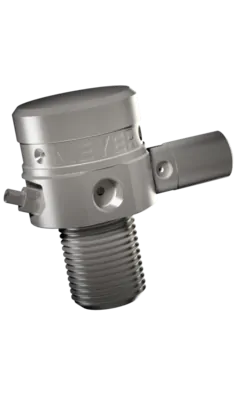
A fuel cell, a thruster or a fill system defines its own pressure window, flow demand and interfaces — and the regulator must be designed to them. MEYER engineers single- and two-stage regulators in hydrogen-embrittlement-resistant materials, up to 700 bar inlet, designed together with the cylinder: one qualified assembly, one mass budget, one supplier.
| Parameter | Reference design |
|---|---|
| Architecture | Single- or two-stage pressure reduction, selected per application |
| Mass | from 125 g — depends on configured architecture |
| Inlet | up to 700 bar capable |
| Materials | Hydrogen-embrittlement-resistant, selected for gaseous H₂ service |
| Integration | Cylinder-integrated assembly — direct M18 × 1.5 mount, no high-pressure interstage plumbing |
| Outlet & flow | Configured to the application’s inlet window and peak demand |
Reference figures describe the design platform; each delivered regulator carries a controlled specification for its configured pressure, flow, interfaces and testing. Catalog classes (350–500 bar supply): HDRX-R series for fuel-cell UAVs · helium service.
Send the problem statement: gas, inlet range, outlet window, flow, envelope, interfaces. An engineer replies within 1 working day.
MEYER proposes the architecture, materials and interfaces — with a controlled specification, price and lead time.
Configured units are built and individually set and verified to the ordered outlet and flow before shipment.
Configuration control, batch testing and documentation for recurring supply — alone or as a matched COPV + regulator system.
Stack inlet windows held stable through the whole flight from 350–500 bar storage. Fitted configurations for IE-SOAR, Aerostak, Protium and Honeywell stacks.
Lighter-than-air & spaceHelium service for airships, HAPS and pressurant systems — regulation from compact high-pressure storage, mass-budgeted with the cylinder.
Matched COPV systemsCylinder + regulator as one assembly: HDRX Type IV storage from 0.5 to 350 L, EU origin, ITAR-free.
Gas, inlet range, outlet window, flow, envelope, interfaces — in whatever form it exists. Sales-qualified inquiries get an engineer’s reply within 1 working day. No marketing automation — one reply, one engineer, signed.