STANAG 2897 Class A: Non-Magnetic Composite Cylinders for EOD/MCM Diving
When an EOD or MCM diver works next to a magnetic-influence-fuzed sea mine, every piece of equipment on their back is a potential trigger. NATO’s answer is STANAG 2897 — the standard that promulgates AEODP-7, “Standardization of EOD Equipment Requirements” — and its Class A “non-magnetic” category: equipment with a magnetic signature low enough to be used in direct proximity to influence-fuzed ordnance. Steel cylinders can never meet it. The traditional answer has been aluminium; the better answer is carbon composite. MEYER’s HDRX cylinders are non-magnetic by construction, matt black by design, and roughly a third of the weight of the aluminium cylinders they replace.
Why magnetic signature decides what a mine-clearance diver carries
Modern sea mines don’t wait to be touched. Influence fuzes listen for the signatures of a target — acoustic, pressure, and above all magnetic: the local distortion of the Earth’s field caused by ferromagnetic material moving nearby. A diver sent to identify or neutralise such a mine must be, magnetically speaking, not there at all. That requirement flows down to every object in the water column with the diver — rebreather, tools, and the breathing-gas cylinder strapped to their back, centimetres from their body and often less than a metre from the ordnance.
STANAG 2897 (AEODP-7) formalises this: Class A (“non-magnetic”) covers equipment approved for use in direct proximity to magnetic-influence-fuzed ordnance, including sea mines. The standard also defines a lower “low-magnetic” class — but that is for equipment approved only at a stand-off distance. For a back-mounted cylinder next to a mine, Class A is the class that applies. It is the rating quoted across serious MCM/EOD diving equipment: Dräger describes its LAR 8000 rebreather as “designed and tested in accordance with STANAG 2897 Class A,” and JFD’s Stealth SC MCM apparatus is rated “non-magnetic to NATO STANAG 2897 A/AEODP-7.”
Steel never qualifies. Aluminium and titanium were the workarounds.
A standard steel cylinder is a ferromagnetic mass — no surface treatment changes that, which is why steel is structurally incapable of meeting Class A. For decades the practical procurement answer has been aluminium-alloy cylinders fitted with non-magnetic valves in bronze or Monel-type alloys. It works, but it carries costs an EOD unit feels every day:
- Weight. Aluminium cylinders are heavy for the gas they carry — a diver’s 6.8-litre aluminium cylinder sits in the 8–9 kg class before the valve. That is fatigue during long approaches, harder boat and airlift logistics, and more mass to trim underwater.
- Service life. Aluminium liners accumulate fatigue with every fill cycle.
- Visibility. Polished or painted metal reflects — moonlight, torchlight, muzzle light. For covert insertion and night operations, glint is a signature of its own.
Navies and specialist units have also fielded titanium cylinders — the premium metal route to a non-magnetic kit. Titanium deserves an honest scorecard of its own:
- Pros: genuinely non-magnetic; roughly 40% lighter than steel at equivalent strength; essentially immune to seawater corrosion, which matters over a fleet’s life in salt water; mechanically very tough.
- Cons: among the most expensive cylinder routes there is — costly raw material, specialist forming and welding, and a very small supplier base with long lead times; still in the ~5–7 kg class for a 6.8-litre cylinder, roughly twice the weight of composite; cycle life remains capped by metal fatigue like any metal-lined vessel; and titanium’s tendency to gall demands careful valve-thread engineering.
Titanium solved the magnetic problem at the highest price point in the market. It never solved the weight problem — it only softened it.
The composite answer: non-magnetic by construction
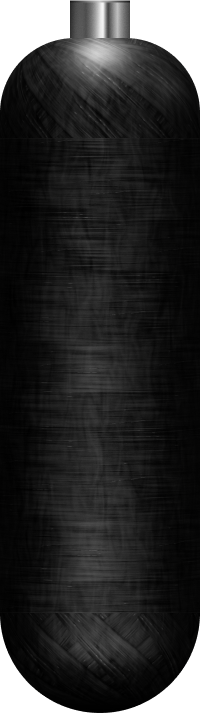
A MEYER HDRX cylinder is a Type IV composite pressure vessel: a polymer liner, aluminium-alloy bosses, and a full carbon-fibre overwrap. There is no ferromagnetic material in the pressure vessel — non-magnetic is not a treatment or a variant, it is what the cylinder is made of. Paired with a bronze/Monel-class non-magnetic valve, the complete assembly is aligned with what STANAG 2897 (AEODP-7) Class A procurement specifies for diver-carried equipment.
The differences a unit notices:
| Steel | Aluminium (traditional EOD) | Titanium (premium metal) | MEYER HDRX composite | |
|---|---|---|---|---|
| Magnetic signature | Disqualifying | Non-magnetic | Non-magnetic | Non-magnetic by construction |
| 6.8 L cylinder weight | ~10–12 kg | ~8–9 kg | ~5–7 kg | 2.8 kg |
| Cycle life | Good | Fatigue-limited | Fatigue-limited | NLL — no limited lifespan, subject to periodic inspection |
| Surface | Painted metal | Painted/polished metal | Bare/anodised metal — can reflect | Matt black composite — no glint, low visual signature |
| Underwater service | Yes | Yes | Excellent (corrosion-immune) | Yes — UW-rated across the HDRX range |
| Cost position | Low | Moderate | Highest | Premium — repaid in weight and NLL fleet life |
The matt-black finish deserves a word, because it is deliberate. Every HDRX cylinder leaves production in a non-reflective matt black — no bright wrap, no gloss lacquer, no high-visibility paint scheme. At night or in turbid water the cylinder does not catch light and does not draw attention. For civilian users this is aesthetics; for military and special-operations users it is the visual half of signature management, and it comes standard.
What to write in the tender
- Specify compliance with STANAG 2897 (AEODP-7) Class A non-magnetic for the complete cylinder-and-valve assembly — the cylinder alone is not the whole magnetic story; the valve must be bronze/Monel-class non-magnetic too.
- Specify the diving-service requirements alongside: underwater rating, breathing-gas compatibility, and periodic-inspection regime.
- For weight-critical procurement, compare on mass per litre of gas carried, not unit price — the composite premium repays itself in diver endurance and logistics.
One caveat worth knowing before you write acceptance criteria: STANAG 2897 / AEODP-7 is a NATO-restricted document. The exact residual-field limits — nanotesla at a defined distance, per class — are not published openly, and formal verification is performed by national military authorities with calibrated magnetometer measurements. If your tender needs the precise thresholds, they must come through your national defence standardization office or NATO EOD channels; we support that process with per-unit documentation and materials declarations on request.
The cylinders
The full HDRX range — 0.5 L to 40 L, 300 bar, TPED/CE/ISO 11119-3 qualified, UW-rated, NLL service life — is available in dedicated -MIL part numbers (non-magnetic valve, matt black, EOD/MCM configuration): HDRX-005-MIL through HDRX-400-MIL. Browse the military/UW segment directly: STANAG-class cylinders in the COPV catalog, or start with the workhorse sizes: HDRX-030-MIL (3 L), HDRX-068-MIL (6.8 L), HDRX-090-MIL (9 L). At the compact end sits the HDRX-008-MIL — 0.8 L at just 0.55 kg, 300 bar working / 450 bar test pressure, NLL, qualified to EN 12245:2009+A1:2011 with π, CE and ISO 11119-3 marking, approved for air and nitrogen, in M18×1.5, 5/8″-18 UNF or 17E threads — the suit-inflation, tool-gas and reserve size that rides alongside the diver’s main cylinder without registering on the scale or the magnetometer. For programme-specific configurations — valve material, thread, manifolding, marking — open an RFQ. Defence UAV programmes should also see our ITAR-free tactical UAV cylinder overview.
Sources
- European Security & Defence — “The right stuff below the waves” (Dräger LAR 8000, STANAG 2897 Class A)
- JFD Stealth SC datasheet — “Non-magnetic to NATO STANAG 2897 A/AEODP-7”
- GlobalSpec — NATO STANAG 2897 (AEODP-7), restricted standard listing
Status current as of July 2026. STANAG 2897 / AEODP-7 is a restricted NATO document; formal Class A verification rests with national military authorities.
HDRX range — carbon-composite cylinders for EOD/MCM diving and military use: non-magnetic construction for STANAG 2897 (AEODP-7) Class A procurement, UW-rated, NLL service life. Browse the STANAG segment →