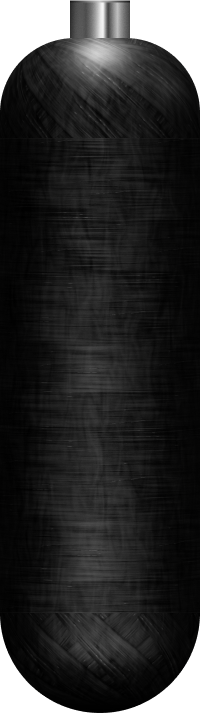
Helium is the hardest gas in industrial use to keep inside a vessel. Its atoms are the second-smallest that exist, it permeates polymers at roughly two to three times the rate of hydrogen, and it escapes through paths no other gas finds — which is exactly why leak-test engineers use it as their tracer gas. So when we say our sealed liner shows no measurable permeation with helium — verified with helium leak detection, the most sensitive escape measurement in industrial practice — we are reporting the hardest test we could run on a composite cylinder. The result: MEYER hydrogen and helium cylinders now hold the un-holdable, at 2.8 kg where metal answers weigh 8–9 kg, with no limited lifespan. Here is what that unlocks, market by market.
Why a lightweight helium cylinder was impossible — until now
A Type IV cylinder — polymer liner, carbon-fibre overwrap — wins every weight comparison there is. But the polymer liner is the gas barrier, and against helium, polymers leak: where a thin-lined composite cylinder loses hydrogen at rates measured in tens of percent per month, helium goes faster still. For applications that fill in the morning and use the gas by evening, that never mattered. For applications that need helium to stay — a pressurant sphere in orbit, a topping cylinder on an airship mast, a tracer-gas bottle between test campaigns — it disqualified composite entirely, and the market defaulted to steel and aluminium, paying for gas-tightness in kilograms.
The MEYER sealed liner closes that path. In qualification testing, cylinders built on it show no measurable loss for hydrogen or helium — below the detection threshold of helium leak-detection equipment. Model it yourself in the permeation calculator: the sealed liner sits at the Type 1 steel reference rate, in a cylinder one-third to one-quarter of the weight. And because the liner is not metal, there is no fatigue cap: the classic HDRX range keeps its NLL — no limited lifespan — rating, and every HDRX size is now available as a dedicated helium part number (-HE suffix) — HDRX-005-HE through HDRX-400-HE. The CE-certified HDRX-068-HE (6.8 L) and HDRX-400-HE (40 L) are available to order, with 120 L and 350 L sizes in development. Browse the helium segment →
Helium pressurant cylinders for satellites and launch vehicles
Helium pressurant is the quiet workhorse of propulsion: it pushes propellant out of tanks, actuates valves, and feeds cold-gas thrusters on satellites and kick stages. Two facts rule this application. First, the pressurant must still be there when the mission needs it — a station-keeping system that bleeds its helium through a polymer liner over eighteen months in orbit is a dead satellite with full propellant tanks. Second, every gram of storage is bought at launch prices — the cylinder’s mass competes directly with payload. Historically those two facts pointed in opposite directions: tightness meant metal, mass meant composite. The sealed liner ends the contradiction — composite mass, metal tightness. For ground-test and reusable-stage service, NLL cycle behaviour adds a third argument the metal-lined alternatives cannot make. Start with our launcher pressure-systems overview and CubeSat cold-gas thruster page, or run envelope trades in the mass calculator.
Helium cylinders for airships, aerostats and HAPS
Every lighter-than-air platform lives on a helium budget — envelopes breathe, fittings seep, and altitude cycling costs lift gas that must be replaced. Cargo-airship programmes, tethered aerostats and stratospheric platforms (HAPS) all need topping helium where the vehicle is: on board, at a remote mast, at an austere operating site. This is the most weight-obsessed customer in the gas business — on an airship, a kilogram of cylinder is a kilogram of lift spent carrying the cylinder. A 2.8 kg composite cylinder replacing an 8–9 kg aluminium one returns its own mass in useful lift several times over, holds its contents indefinitely thanks to the sealed liner, and its NLL rating fits fleets planned to operate for decades.
Helium tracer-gas cylinders for leak testing and industry
Helium tracer-gas testing is everywhere serious tightness is verified — automotive fuel and AC circuits, refrigeration, semiconductor tools, medical devices. And helium is expensive, supply-constrained, and increasingly rationed. That gives permeation a price tag: a tracer-gas cylinder that loses content between test campaigns is a recurring invoice, and a portable service kit built on steel is a two-person lift. Sealed-liner composite cylinders hold tracer gas without loss between uses, cut kit weight by two-thirds for field service teams, and — because helium recovery systems increasingly close the loop — make the storage side of recovery as tight as the recovery itself. The permeation calculator shows the loss-rate comparison per liner type directly.
Helium cylinders for scientific ballooning and field research
Radiosonde stations, university stratospheric programmes and field campaigns launch from wherever the science is — which is rarely next to a gas depot. Helium logistics decide what a campaign can do: cylinders are carried by truck, boat, sled and hand to remote launch sites. Cutting per-cylinder mass from ~9 kg to 2.8 kg changes how much gas a team can position per trip, and the sealed liner means the gas positioned in autumn is still there for the spring campaign. For institutional fleets, NLL removes the cylinder-retirement clock that steel and aluminium impose on procurement cycles.
The engineering summary
| Steel | Aluminium | MEYER sealed-liner composite | |
|---|---|---|---|
| He permeation | None | None | No measurable loss (He leak-detection verified) |
| 6.8 L cylinder weight | ~10–12 kg | ~8–9 kg | 2.8 kg |
| Cycle life | Good | Fatigue-limited | NLL (classic HDRX range), 20 yr (HE SKUs) |
| Availability | Commodity | Commodity | Dedicated -HE part numbers, π/CE/ISO certified; available to order |
The honest footnote, as always: “no measurable” is a measurement statement — losses below helium leak-detection thresholds under qualification test conditions — and whole-system tightness includes your valve and fittings, which is why we offer validated cylinder–regulator development. Measured data for a specific SKU ships with the certificate documentation.
HDRX-068-HE (6.8 L, 2.8 kg) & HDRX-400-HE (40 L) — CE certified, sealed liner, no measurable permeation; every classic HDRX model also available with helium approval. Browse helium cylinders → · Programme RFQ →